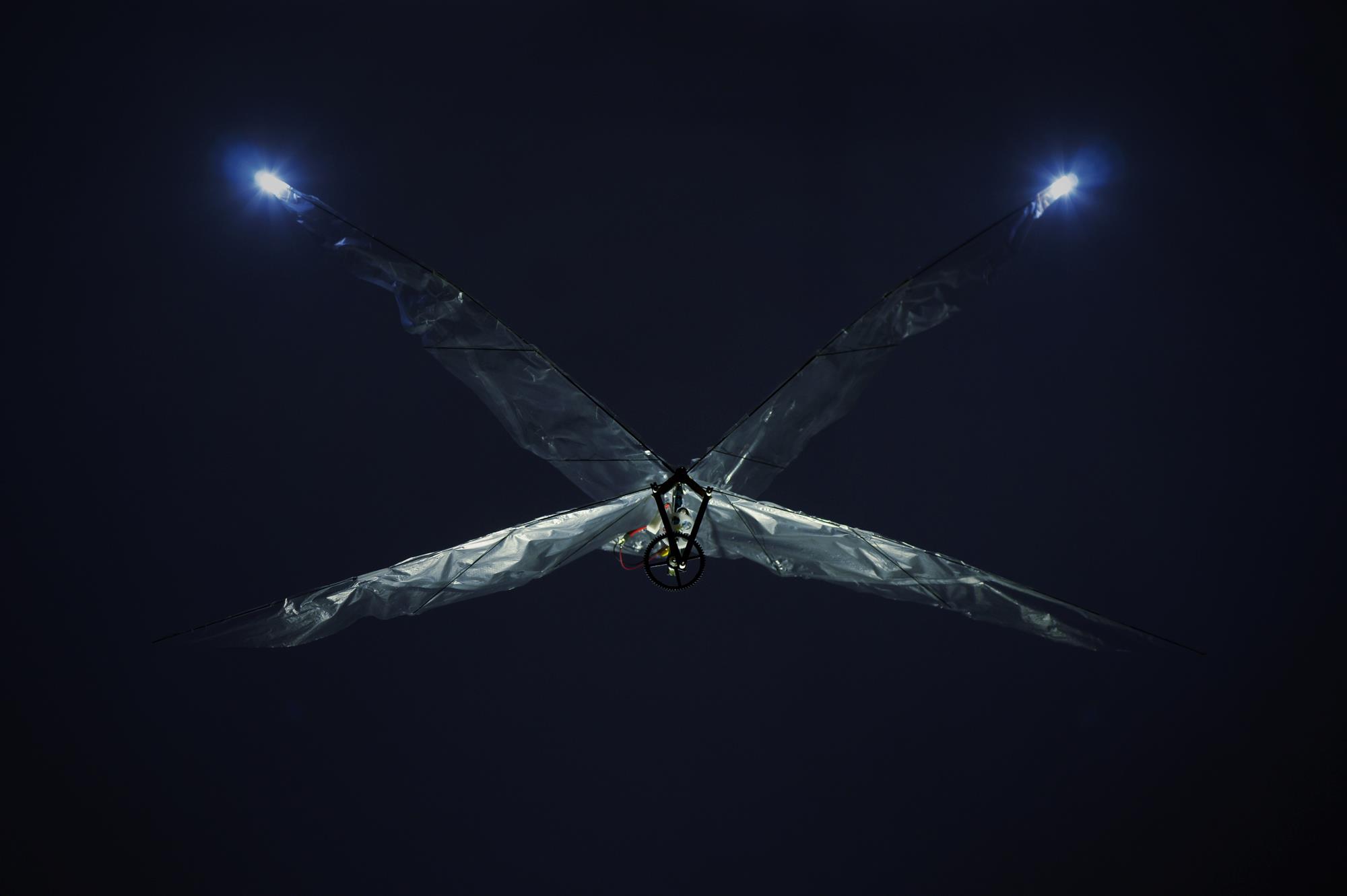
Volucris is a collaborative project developed by Hyuns Hong and Wonbin Yang that investigates foundational questions surrounding artificial life and the criteria by which life is defined. Originating from a shared interest in the ontological boundaries between organic and machinic forms, the project examines how notions of vitality, agency, and evolution are constructed and constrained within contemporary understandings of living systems.
The work introduces a series of winged, flying artificial creatures and articulates speculative evolutionary trajectories for these entities. By designing beings that operate outside biological substrates yet exhibit life-like potentials, Volucris interrogates the conceptual assumptions that underlie distinctions between the natural and the artificial. The project does not seek to replicate biological evolution, but instead uses non organic forms to question how evolutionary logic itself might be reinterpreted when applied to machinic or computational entities.
Through these constructed life forms and their imagined developmental pathways, Volucris addresses broader philosophical inquiries: What constitutes a living being when materiality, reproduction, and adaptation are decoupled from biology? How do classification systems shape what counts as life and what falls outside its definitional boundaries? And to what extent might artificial entities generate their own evolutionary conditions, thereby challenging anthropocentric and biocentric frameworks?
Positioned at the intersection of artificial life studies, speculative ontology, and digital materiality, Volucris proposes evolution not as a strictly biological process but as a conceptual tool for reconsidering how forms of being emerge, differentiate, and persist across organic and non organic domains.
Project Documentation:
Evolutionary Studies and Configurations
1. Foundational Configuration and Ancestral Variants
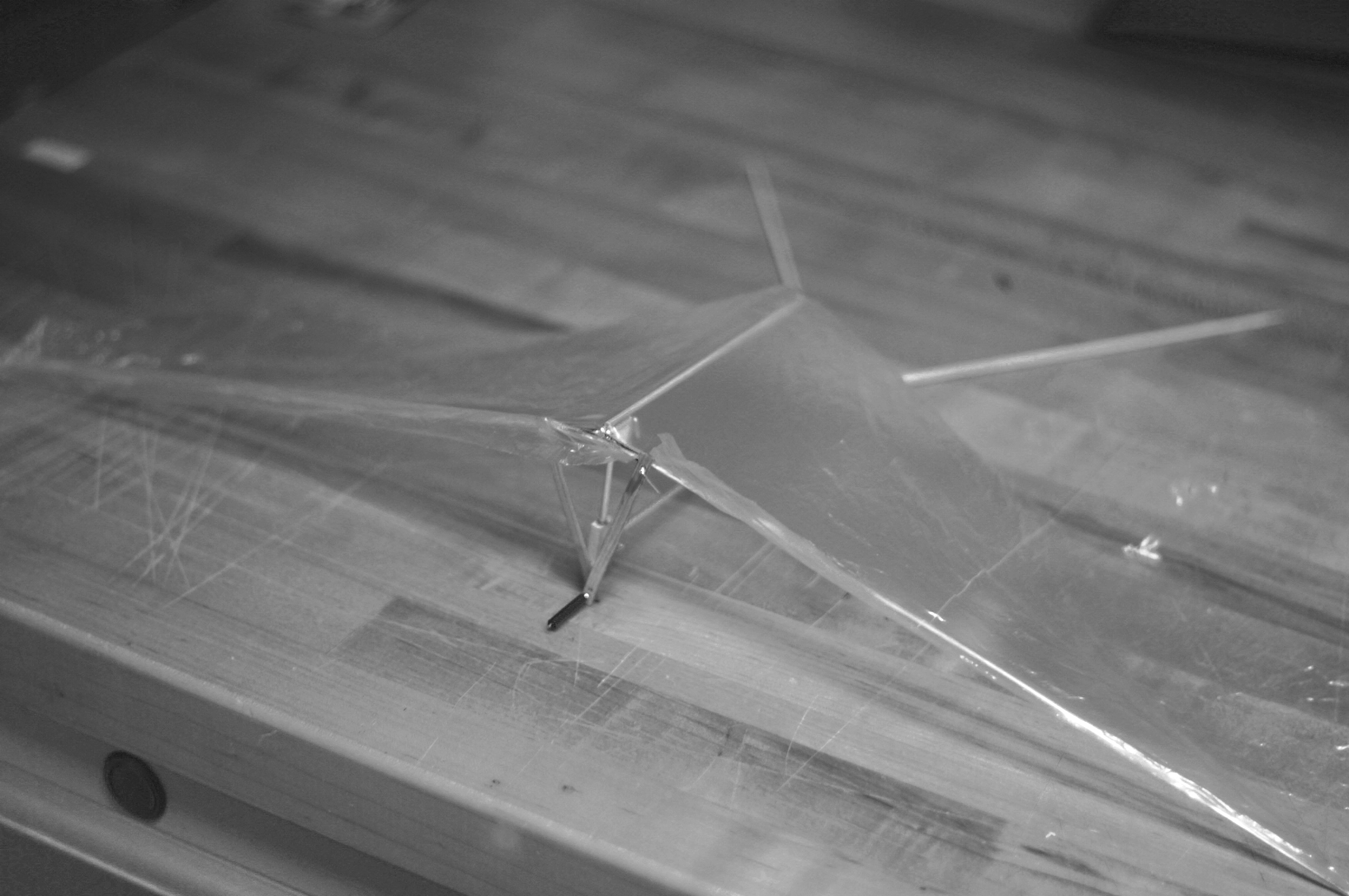
Figure 1.1, Foundational Configuration construction
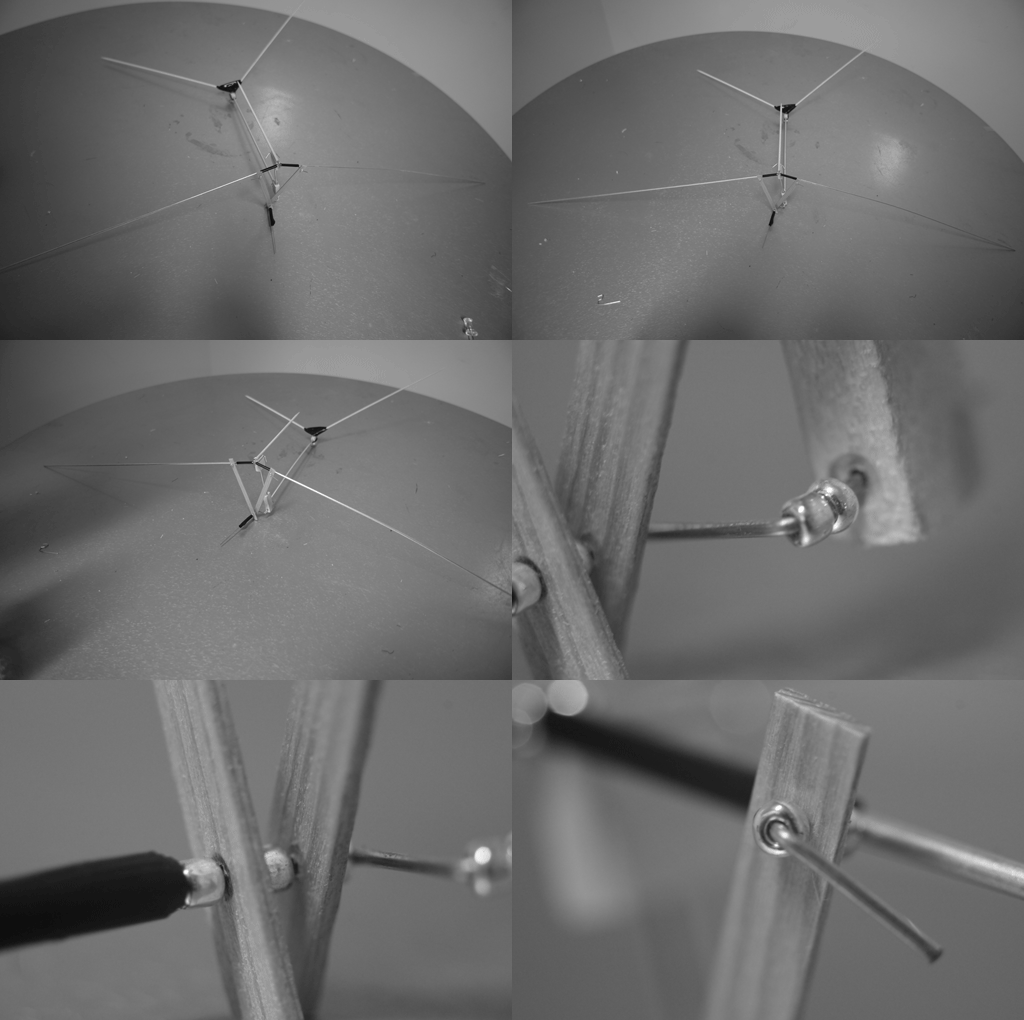
Figure 1.2, Foundational Configuration construction, details
These images present one of the Ancestral Variants of Volucris in Foundational Configuration. The wing dimensions, joint architecture, and power source connections were determined through computational calculations generated by Hyuns Hong's custom designed software. Using this system, numerous virtual variants were simulated, evaluated, and selectively transitioned into physical form. For this construction, light wood, aluminum piping, thin plastic sheeting, fine metal wire, and small beads were chosen to achieve a minimal, lightweight body structure.
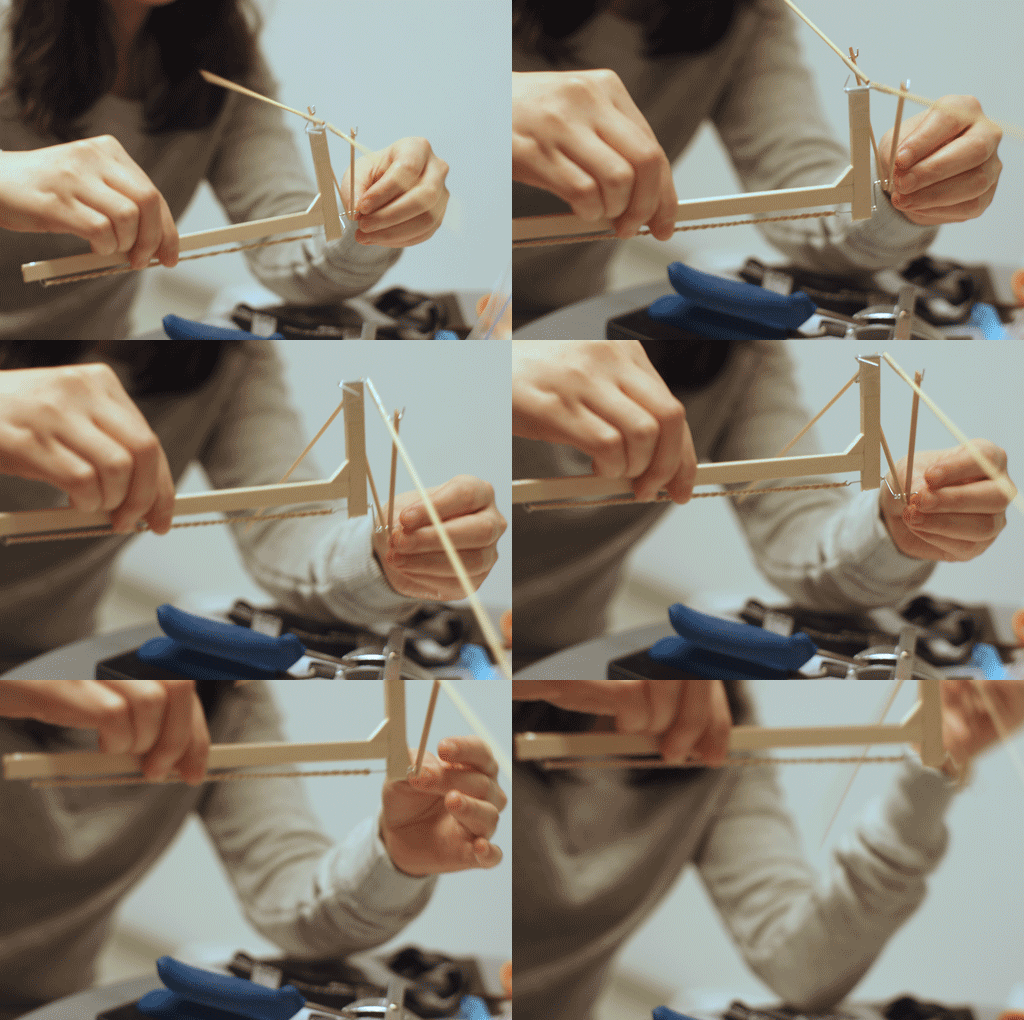
Figure 1.3, Ancestral Variant with a rubber-band power system
This Ancestral Variants employs a rubber-band power system. In the early stages of Volucris, rubber was chosen not only for its mechanical usefulness but for its conceptual resonance: as a natural material capable of storing and releasing energy, it anchors the project's exploration of how organic forces might be reinterpreted within machinic beings. The torsion and release of the band operates as a small philosophical study, an inquiry into how vitality, tension, and potentiality circulate between natural and artificial domains. Fellow artist Kahyun Yun testing one of these ancestral models during a studio visit as part of its early operational evaluation. (Figure 1.3)
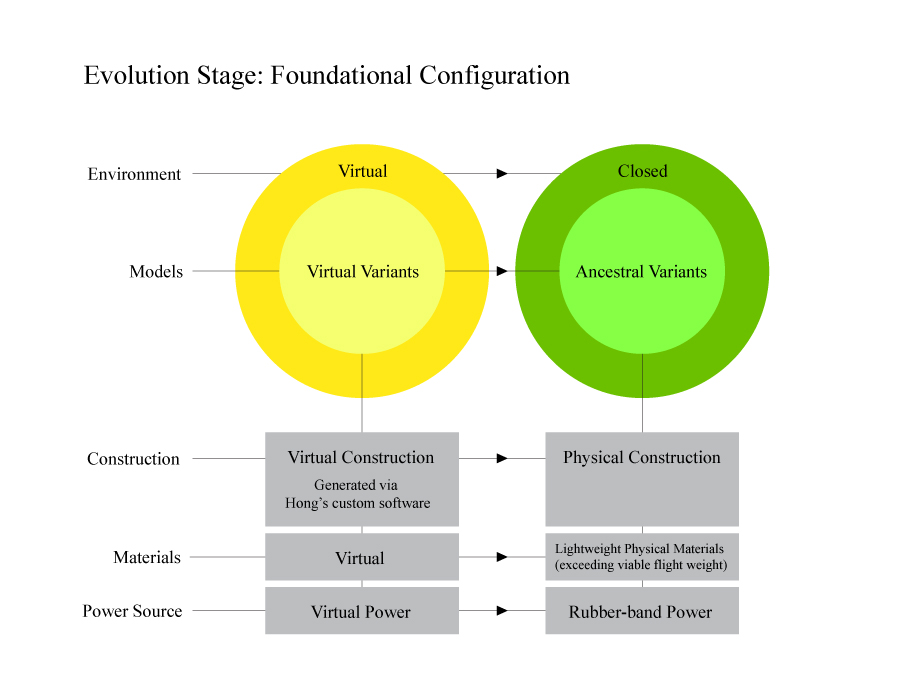
Figure 1.4, Foundational Configuration
2. Evolved Configuration: Electronic and Gear Evolution
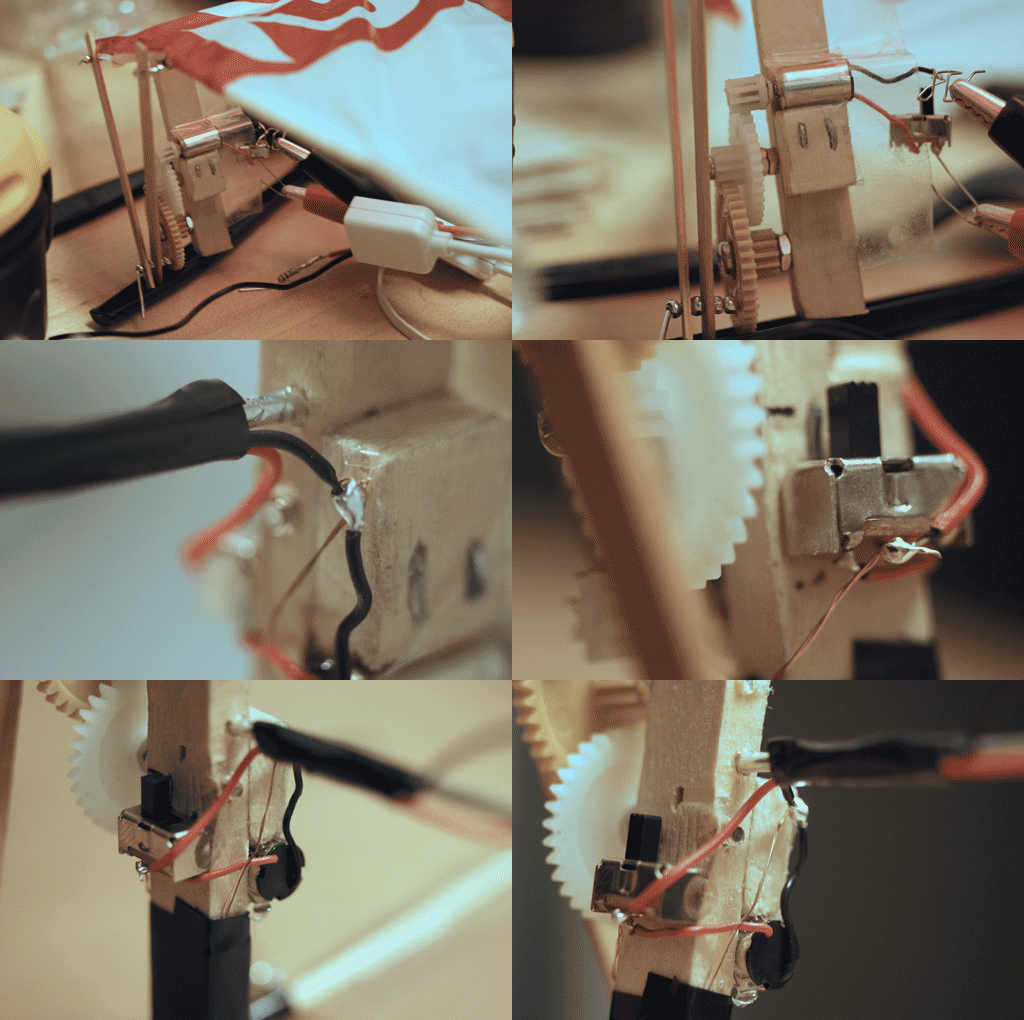
Figure 2.1, Transitional Variant with electronic evolution
This Evolved Configuration marks a transition in Volucris toward electronic evolution. A micro DC motor, powered by a compact lithium cell, drives the wing mechanism through a multi gear system designed for efficient power transfer. While this shift appears to depart from earlier, nature-oriented energy systems, it raises a deeper question: what counts as "natural" in the first place? Electronic components are themselves mineral, elemental, and continuous with the material processes that constitute organic bodies. This stage of Volucris therefore opens a broader inquiry at what point does a mechanical system cease to be considered natural, and how do our definitions of machine and organism shape what we recognize as life?
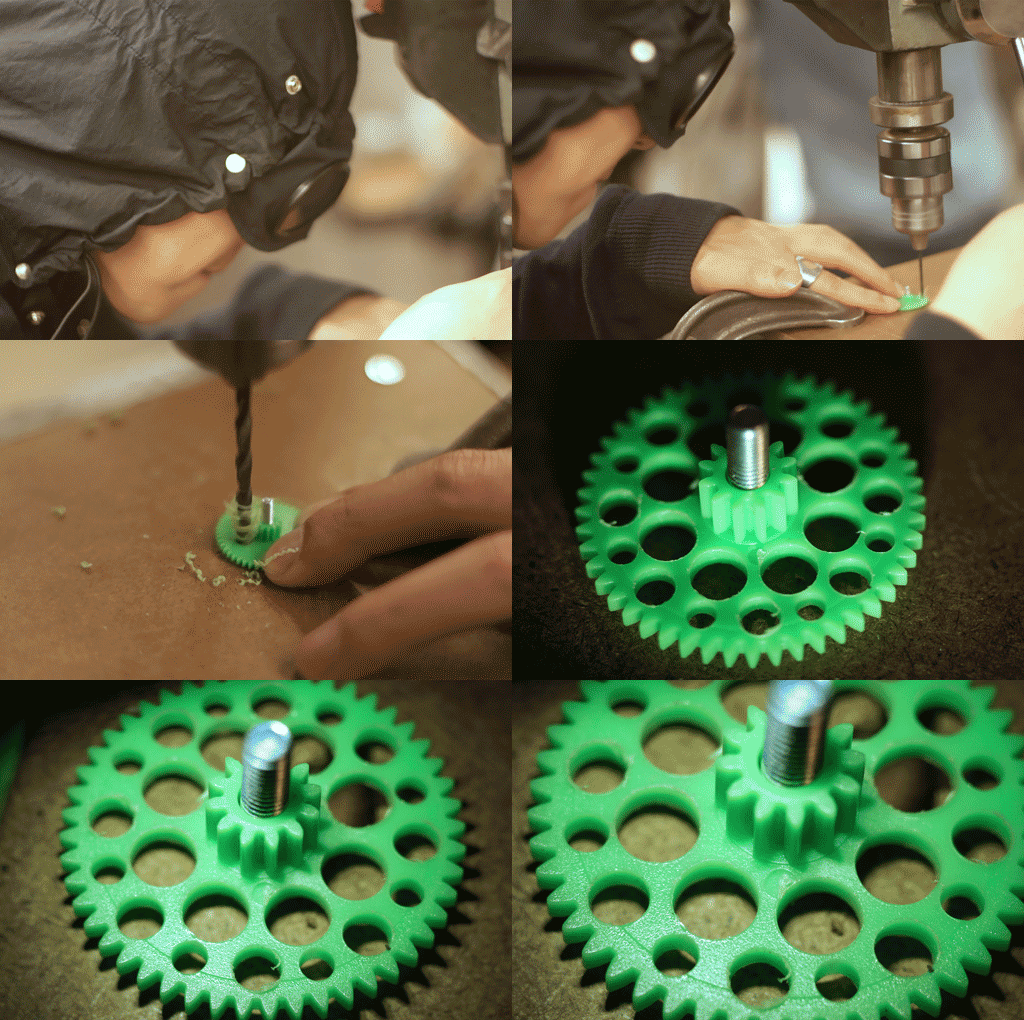
Figure 2.2, Transitional Variant with lightweight gear evolution
In this Evolved Configuration, even the weight of a small plastic gear becomes critical to flight. To reduce mass, multiple holes of varying diameters were cut into each gear, allowing the component to retain structural integrity while minimizing load. These selective design decisions constitute a form of synthetic evolution: iterative modifications driven by constraints, experimentation, and feedback rather than biological inheritance. This raises a broader question—does nature refine organisms through an equivalent logic of selective pressures, or is evolutionary complexity the result of contingent, accumulated events? Volucris positions itself within this uncertainty, asking where design, chance, and necessity converge in the emergence of both natural and artificial forms. Hong is seen here operating a press drill to create the weight-reducing perforations in the gear. (Figure 2.2)
3. Evolved Configuration: Illuminated Wing Tips
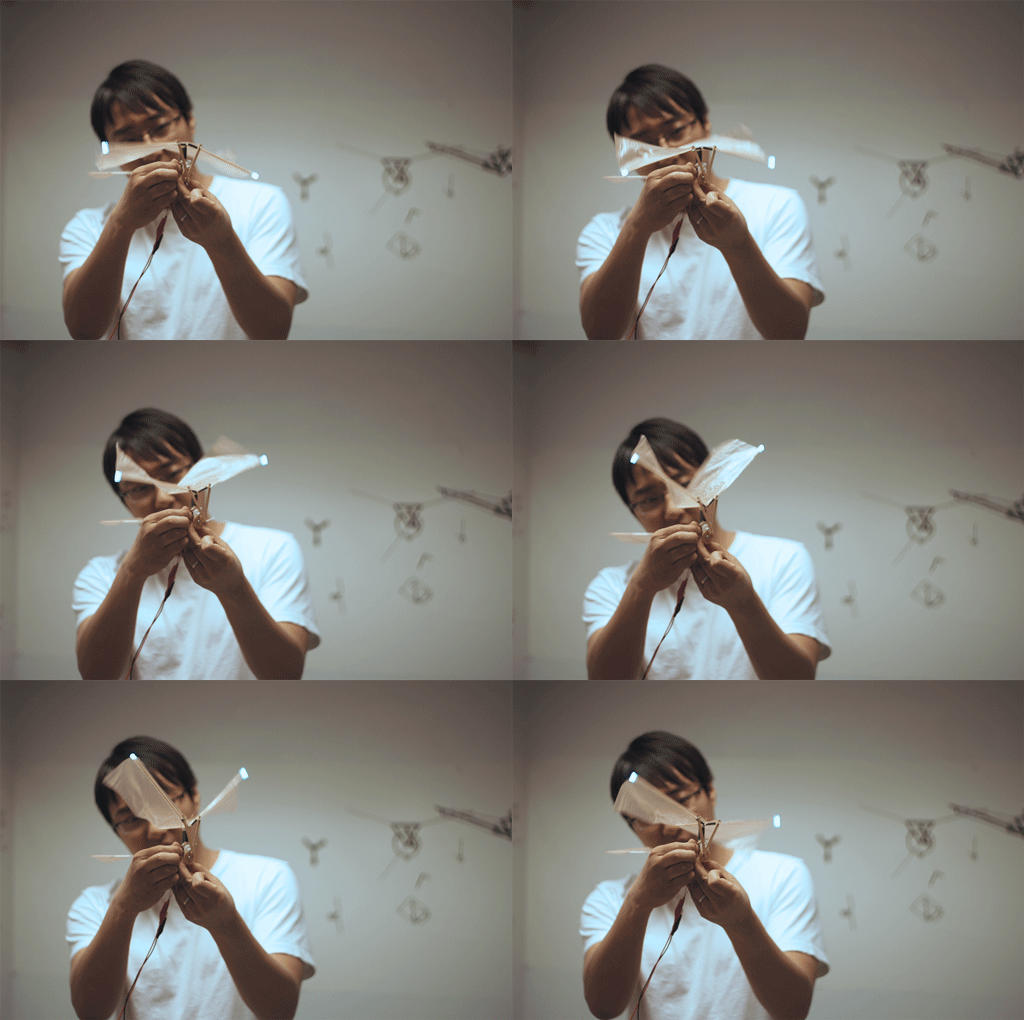
Figure 3.1, Integrated Luminous Variant with illuminated wing tips
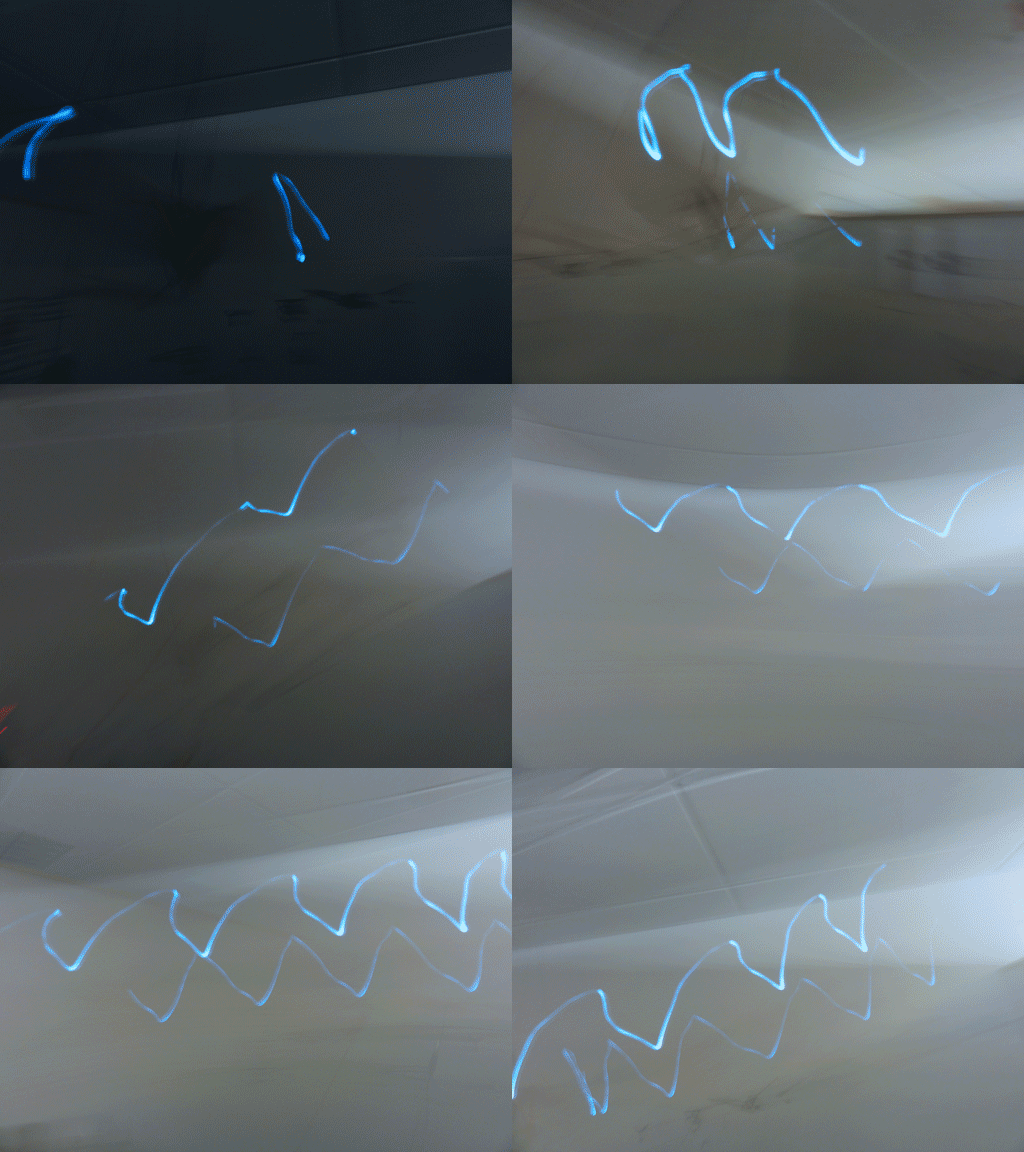
Figure 3.2, Integrated Luminous Variant, luminance behaviors and patterns.
Within the Integrated Luminous Variants, Volucris incorporate illuminated wing tips. Lightweight light-emitting diodes are embedded into bodies cut to the threshold of structural limitation, with power delivered through hairline copper wires. The resulting light emissions generate distinct patterns, each functioning as a kind of expressive signature, a visual language emerging from the essence of each variant's engineered life. Yet these creatures possess no capacity to perceive their own luminance. This raises a set of speculative questions: for whom are these signals produced? Do they constitute a form of interspecies communication, an unintended byproduct of their construction, or a role assigned by forces we might call "natural" within a non-natural system? Yang is shown here holding one of the early Integrated Luminous Variant as its light language becomes visible (Figure 3.1).
Figure 3.3, Integrated Luminous Variants with illuminated wing tips, early integration test (Video)
This video captures light-emitting diode embedded Volucris variants in wing flip motion. In this early integration test, an external power source sustained the prototypes as their initial luminous behavior emerged, offering a first glimpse of the light language developed in later stages.
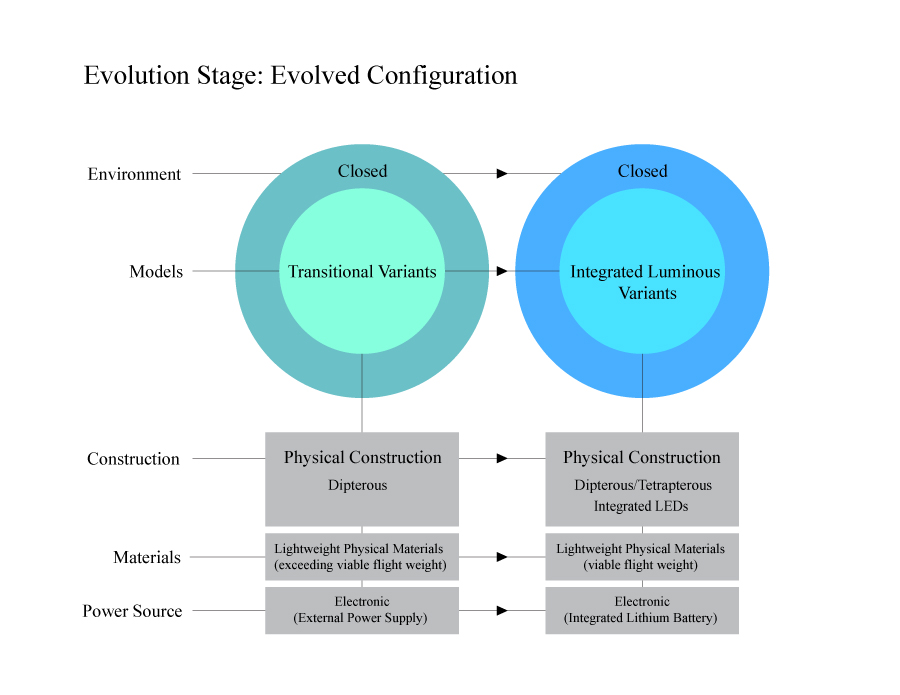
Figure 3.4, Evolved Configuration
4. Apex Configuration: Carbon-fiber and Six-winged Construction
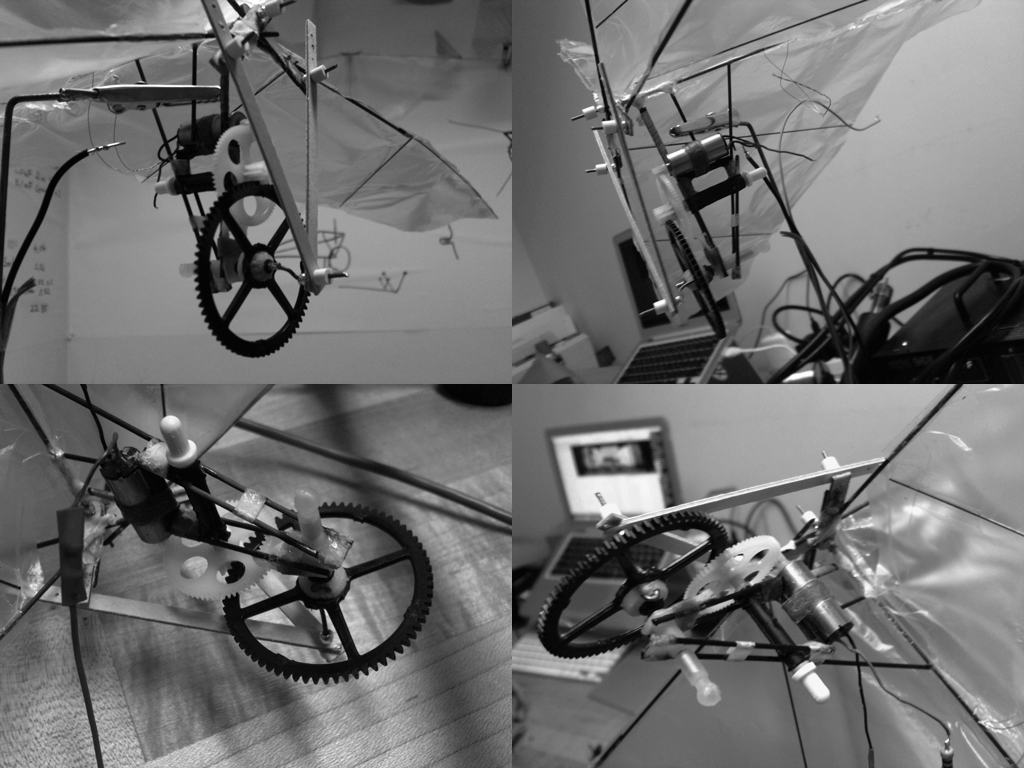
Figure 4.1, Apex Configuration, carbon-fiber construction
In Apex Configuration, Volucris employs a carbon-fiber wire body construction, a framework that achieves ultimate lightness while preserving structural integrity. Yet beyond its material efficiency, this architecture gestures toward a philosophical horizon. Ultra-light construction becomes not merely an engineering achievement, but a meditation on the minimum conditions required for form to persist. Volucris demonstrates that when weight approaches its limit, structure begins to behave less like a static object and more like an organism negotiating the forces of its environment.
In this sense, the carbon-fiber wire body is not a skeleton but a proposition: that complexity can arise not from mass, but from the tensioned relationships between parts. Volucris's design suggests that evolution biological or technological need not move toward thicker armor or greater density but can instead proceed toward transparency, openness, and interdependence. The body becomes a field of forces rather than a closed volume; the wing becomes a vector rather than a surface.
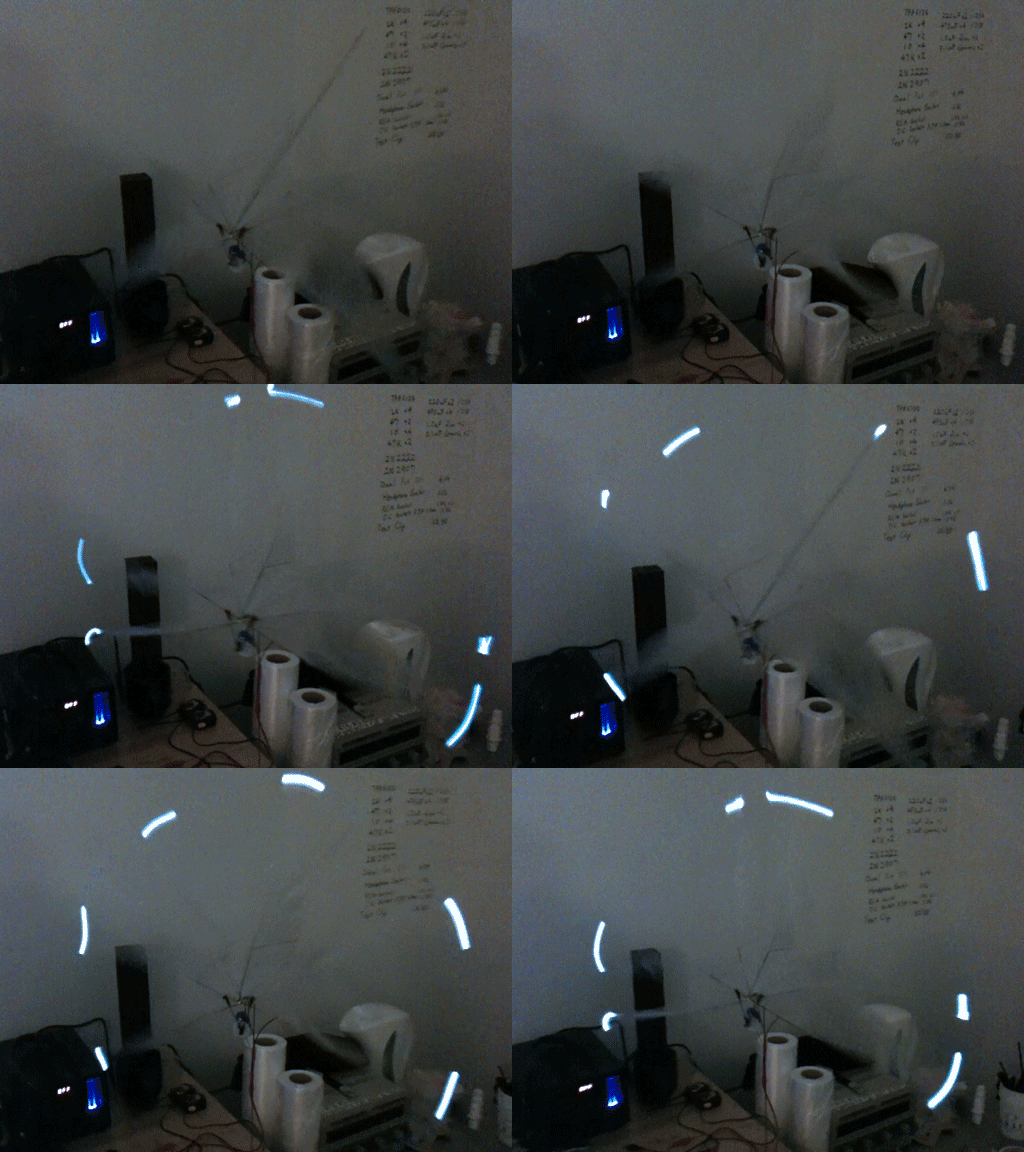
Figure 4.2, six-winged construction
This configuration shows a six winged Volucris, opening a possible evolutionary path toward more complex wing and body systems. Volucris hints at a future in which machines emulate the logic of natural systems: structures capable of change, tuned to the world rather than dominating it, shaped by the ambient conditions of air, light, and motion. Philosophically, this shift echoes a broader reorientation, moving away from the solidity of classical metaphysics toward a dynamic ontology of relations. The lightweight construction becomes a metaphor for being itself, not a thing but a pattern of tensions, not an essence but a capacity to respond.
If heavier machines embody a worldview of control and permanence, Volucris embodies a worldview of reciprocity and becoming. It imagines flight not as the overcoming of gravity but as a cooperation with it, turning the body into a negotiation rather than a conquest. In this way, Volucris becomes both a technical prototype and a philosophical diagram, a sketch of how futures might be built not by adding more but by learning how to hold together with less.
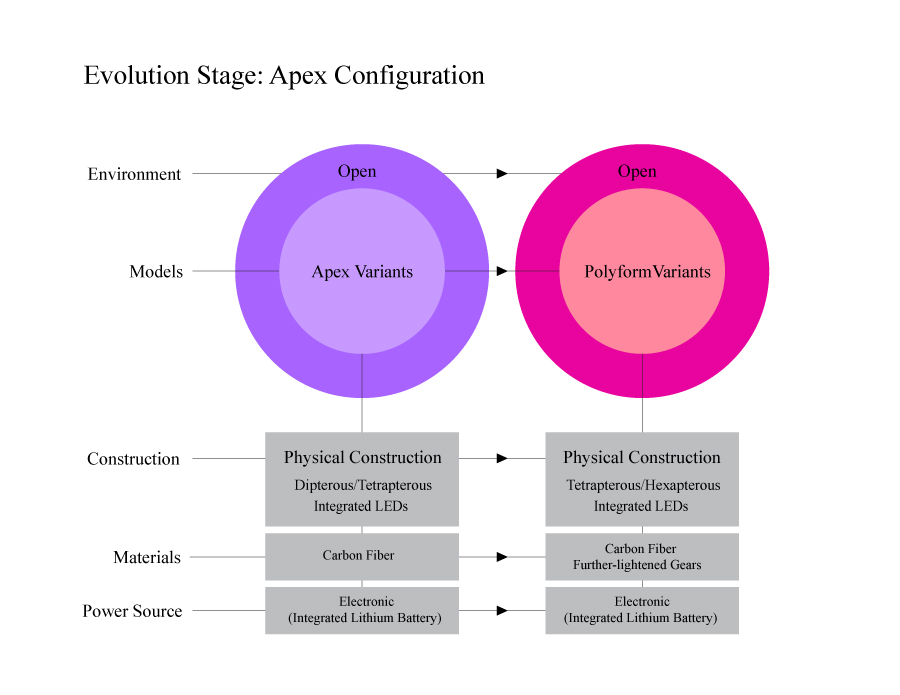
Figure 4.3, Apex Configuration
5. Apex Variants in Open Environment
Figure 5.1, Apex Variant (Tetrapterous Model) in open environment (Video)
Figure 5.2, Apex Variant (Tetrapterous Model) with illuminating wing tips in open environment (Video)
Figure 5.1 and Figure 5.2 present the Apex Variants of Volucris, early evolutionary studies in which mechanical flying organisms are formed through structures that embrace fragility as a fundamental condition of existence. Constructed from carbon fiber wires and miniature electronics, these Apex bodies are not fortified machines but exposed organisms, open to the shifting pressures of air and proximity. A passerby’s movement, a brief turbulence, or a subtle change in airflow can redirect their flight, unsettle their equilibrium, or fold them momentarily to the ground.
In the Apex lineage, fragility becomes a mode of intelligence. It requires the organism to remain in continuous negotiation with the forces around it, cultivating a form of responsiveness that is inseparable from vulnerability. The flight paths and pulses of illumination recorded here function as early expressions of this relational behavior, revealing how these bodies communicate their state within an environment that can sustain or disrupt them at any moment.
This relational fragility sets the conceptual groundwork for the later and more elaborate Apex configurations, including the six-winged Volucris. The increase in structural complexity does not erase vulnerability; instead, it expands the ways in which the organism can sense, respond, and adapt. Evolution, in this context, is not a march toward invulnerability but a deepening attunement to the world's forces.
Through this lens, the Apex Variants operate as philosophical diagrams of a different mechanical future one in which the capacity to persist emerges not from armor or mass but from the ability to remain open, exposed, and continually in dialogue with the environment that shapes and challenges them.
6. Additional Materials
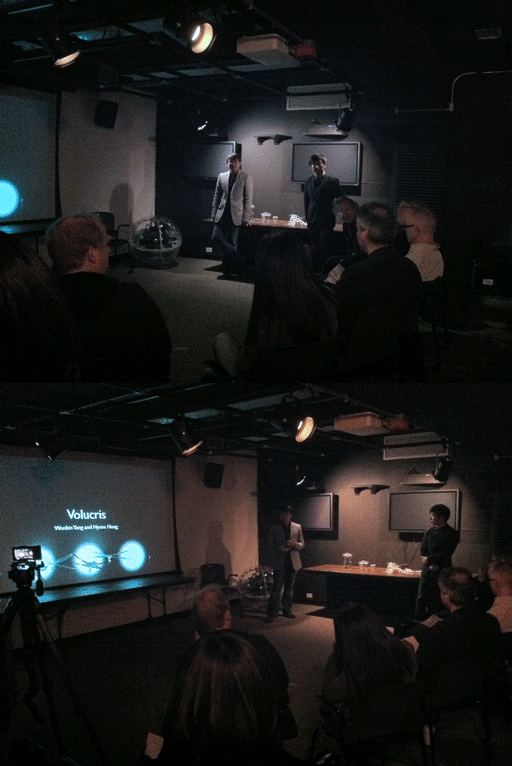
Figure 6.1, Volucris Presentation
In this presentation of Volucris, a range of variants was displayed together with the project's developmental trajectory. The discussion addressed artificial life, classificatory frameworks, speculative ontology, and digital materiality, situating Volucris within the broader discourse of non-organic evolutionary systems.
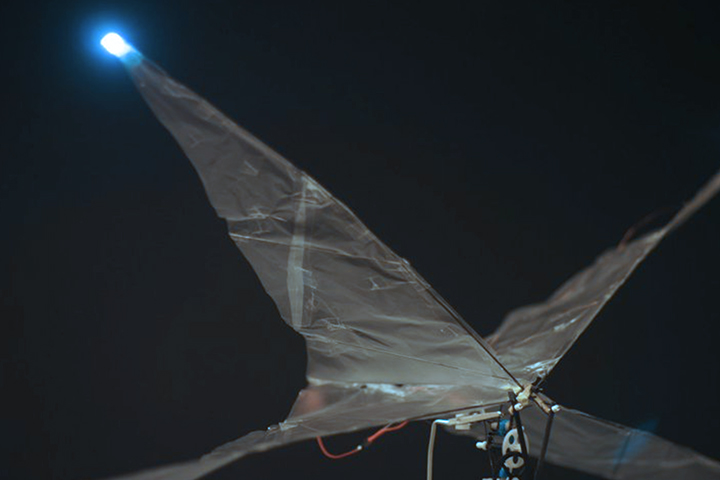
Figure 6.2, Volucris - Apex Variant (Tetrapterous Model)
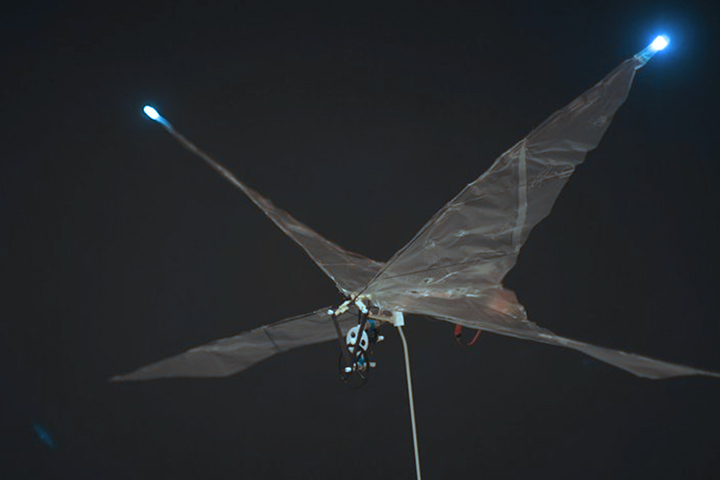
Figure 6.3, Volucris - Apex Variant (Tetrapterous Model)
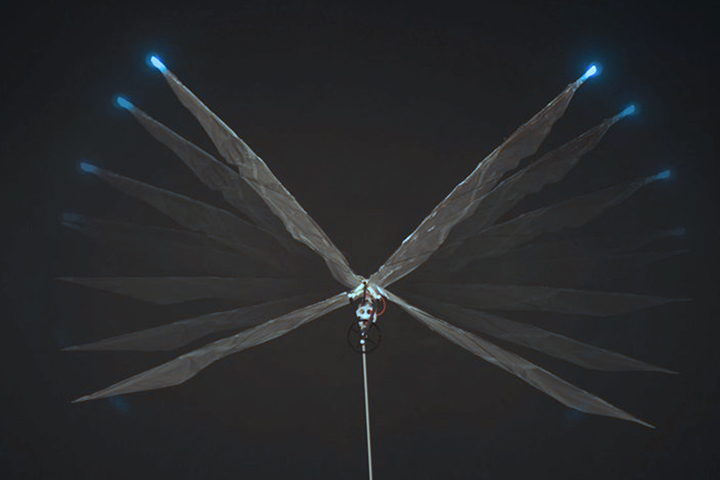
Figure 6.4, Volucris - Apex Variant (Tetrapterous Model), wing motion time-lapse
Acknowledgements
With sincere appreciation to Hyuns Hong and all who supported the Volucris project.